

The Elderly area Söder
The current area is directly linked to the two certified Purple Flag areas and includes the Söder district with its buildings, parking lots and streets. Primary areas are mainly the commercial area, but to cover residents and students there is also a secondary area.
The light area within the oval is the primary area for businesses. The darker area is the primary area for residents and students.
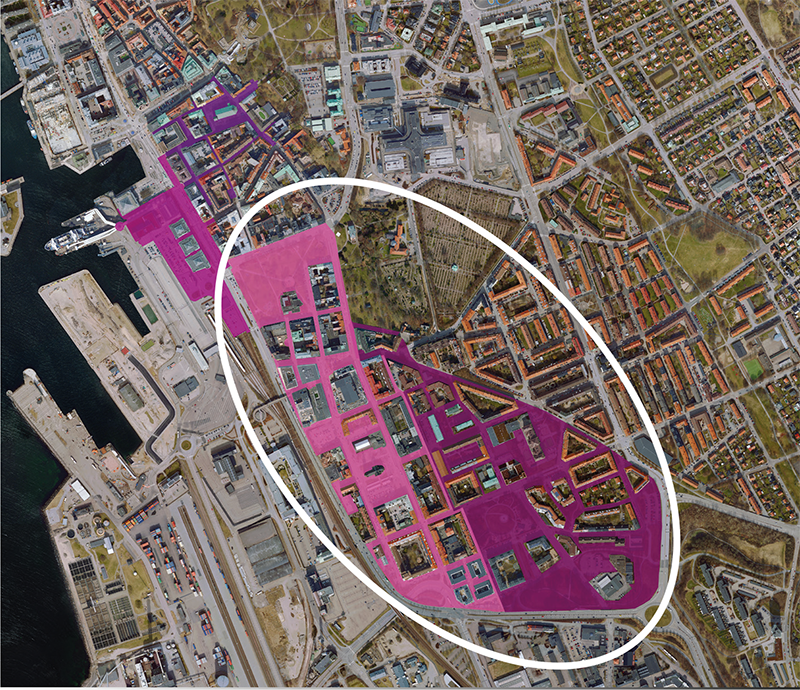
The current area is directly linked to the two certified Purple Flag areas and includes the Söder district with its buildings, parking lots and streets. Primary areas are mainly the commercial area, but to cover residents and students there is also a secondary area.
In the 19th century, industries and workers’ quarters were established in Söder, largely due to its proximity to the port and the railroad, which laid the foundations for segregation in the city and towards the northern districts. The area changed as the industries moved away and gave way to new housing, shops and offices. There is still a clear difference between the south and the north. Söder has a multicultural character in the range of shops and restaurants. The area is currently perceived as littered and very unsafe and occasionally untidy, even though improvements have been made during the course of the work with the Älskade site collaboration Söder. Söder is an area in which several serious crimes have been committed and the perception is still that there is a high level of crime concentrated in this part of the city, among others.
Within the area there are several student residences, student union buildings, rental apartments and condominiums and even though the area is perceived as unsafe through, among other things, the police’s safety measurement, many people feel good.
Söder has been on the agenda on several occasions with the aim of raising and improving the perception of the district and its reputation, especially with regard to litter, insecurity and segregation.
In the 1990s, the “Hela Söder” project started with an action program to develop the district. There were discussions about burying the railroad to get a better connection to the west and the port area.
In the 2000s, the process “Söder in change” was initiated with the aim of lifting the district through physical changes and increasing integration and thus the attractiveness of the area. In the spring of 2006, several of the identified change projects were completed, such as the conversion of Södergatan into a bus street with cycle lanes and the redesign of Gustav Adolfs torg.
In connection with the city’s decision to build the Södertunnel (undergrounding of the railroad), the H+ urban renewal project was initiated in the port area. This would shift the center of gravity of the city center southwards and the district Söder would become more central and have a direct connection to H+ and the sea.
In 2000, the Campus was established in the H+ area directly east of the railroad. The hope was that the students would lift the district with their presence. Several student residences have been built in the vicinity of Furutorpsplatsen and there has also been a student union building here for a few years.
The Södertunnel was not realized but Söder is connected to the Campus via a pedestrian and bicycle bridge over Järnvägsgatan and the railway.
A new entrance from Helsingborg Central Station has been built in line with Stadsparken and Järnvägsgatan has been rebuilt to enhance pedestrian and bicycle traffic to Söder.
In 2014, the municipal council decided that a development plan for the south should be drawn up. “Think about/South” was the result of an analysis of the current situation, dialogues and urban analysis. The development plan also contains concrete proposals for measures in both the short and long term. Several of these have now been implemented.
The H+ area is under construction in phase 1 at Oceanhamnen where housing, offices, hotels and a pedestrian and bicycle bridge between H+ and Helsingborg Central over the ferry landing area and the harbor basin are currently being built.
Despite the focus on action in the area, it has not had the desired effect. The area is still perceived as littered, unsafe, forgotten and segregated. In the fall of 2018, politicians proposed to make Söder the third Purple Flag area in the city.
The city council gave a clear assignment to the city planning administration to work on our joint and individual responsibility for a cleaner Helsingborg. The city must be clean and safe and safeguard an attractive urban environment. Vandalism and littering contribute to a deteriorating urban environment, but also to a more insecure city where the threshold for committing crimes is reduced. The assignment highlights an ongoing project “A Söder where everyone can thrive”, which means that the city will raise awareness among residents about how littering negatively affects safety.
Söder also has many positive features that need to be highlighted and developed further. From the north, there has been regeneration through the construction of the Radisson Blue hotel, office buildings and housing, as well as extensive redevelopment of the Söderpunkten shopping mall, now called SöDER, which houses a wide range of restaurants, shops, gyms and Filmstaden. This has contributed to increased visitor numbers in the northern part of the southern part of the city.
In the middle of the area is Gustav Adolfs torg with the church and the old swimming pool.
In our work, we will primarily focus on complete, clean, tidy and safe. Achieving this requires collaboration and participation in a widespread way.
Söder is a complex area with deeper issues, which are not only related to public space. The issue of gender equality is essential, as is the issue of integration. Activating and finding destinations for a broader group, creating pride and ownership. At the same time, Söder’s history and diversity become an asset and an identity.